Skip to Main Content
From as low as $35/mo* Prequalify Now
30-Day Price Match Guarantee
365-Night Home Trial
Forever Warranty™
Free Shipping & Returns
Find in Store

Bedding

Published June 15, 2026

7 min

When to Replace Your Pillow

For when your neck has been quietly unhappy for weeks and you're not sure why.


 Nectar Editorial Team Author Image
Nectar Editorial Team
Spotlight Image
Table of contents
The Fold TestHow Long Should a Pillow Last?Signs It's Time to Replace Your PillowWhat Actually Wears Your Pillow OutHow to Make Your Pillow Last LongerWhat to Look for When You Replace Your PillowWhen It's Done, It's DoneFrequently Asked Questions
Your pillow has one job: keeping your head and neck in line while you sleep. When it stops doing that, your muscles take over (and they'll tell you about it in the morning(. Sore neck that's fine by noon, a shoulder that's been off for no obvious reason – here's how to figure out if your pillow is the problem, and what to actually look for when you replace it.https://res.cloudinary.com/dxeq6jwsb/image/upload/v1781304613/Hackathon%202026/nectar/pillowtype/pillowtype-inline-2.webp
The Fold Test

Fold your pillow in half and hold it for 30 seconds. Let go. If it springs back flat, it's probably still good. If it stays folded, or barely moves? The fill is done, and fluffing won't change that.For memory foam, press down with your palm and release. If the impression lingers for more than a few seconds, your foam has lost its spring.https://res.cloudinary.com/dxeq6jwsb/image/upload/v1781304611/Hackathon%202026/nectar/pillowtype/pillowtype-inline-1.webp

How Long Should a Pillow Last?

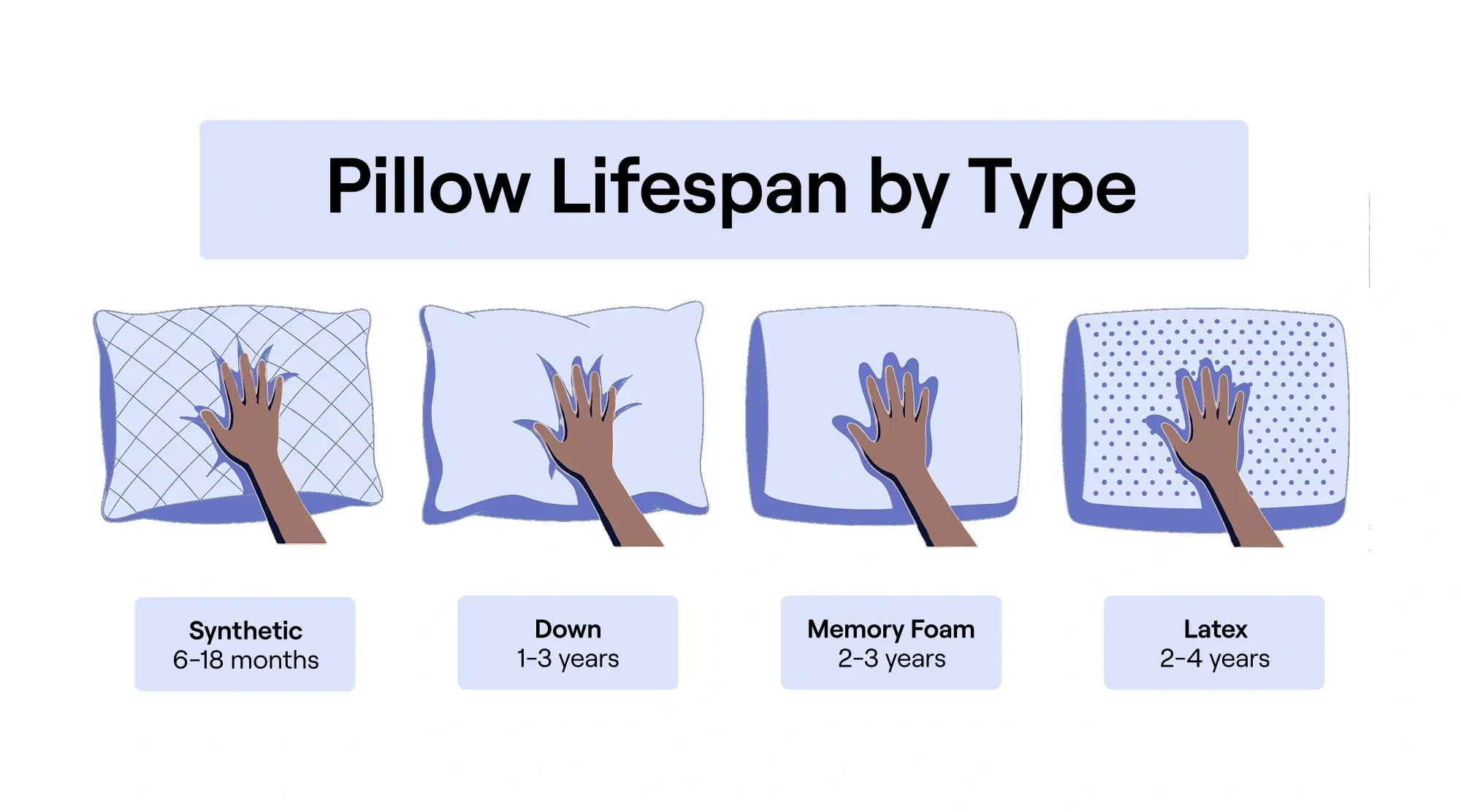
It depends almost entirely on what's inside.Synthetic (polyester fill): 6–18 months. Breaks down the fastest. Cheaper pillows go sooner; better-made ones can stretch toward 18 months. Either way, it's the fill type you’ll find yourself replacing most often.Down and feather: 1–3 years. Natural fill compresses and clumps over time. How well you take care of it matters — a protected, regularly washed down pillow can push past that range.Memory foam: 2–3 years. Memory foam tends to hold its shape well, and the cover usually wears out before the foam does. Heat, washing habits, and whether you use a protector all play a role.Latex: 2–4 years. This is the most durable of the bunch. Resists compression, bounces back consistently.Keep in mind, these are averages! A pillow giving you neck pain at 18 months needs to go, while one still passing the fold test at three years doesn't.

Not sure which mattress fits you best? Find out now.

Signs It's Time to Replace Your Pillow

You wake up stiff but it works itself out by mid-morning. That's your neck compensating overnight for a pillow that's stopped holding its shape. When the support goes, your muscles do the job instead — and you’ll certainly feel it eight hours in.Lumps that don't fluff out. Once fill shifts and clumps, it's not coming back. (Fluffing masks it, but only for about ten minutes.)It's gone yellow. Some discoloration over time is just what happens — sweat and body oils work through even a clean pillowcase. When it's heavily yellowed, the fill has absorbed enough that washing won't actually make a difference.It holds onto smell. Old fill absorbs sweat and oils over months and years. Eventually, it just doesn't wash out.You've started sneezing at night. Old pillows collect dust mites faster than most people realize. If your nose runs every time you lie down, the pillow's worth ruling out first.

What Actually Wears Your Pillow Out

Every night your pillow compresses under the weight of your head and tries to recover. Over time, fill stops bouncing back — it’s not a defect, that's just what happens. There are things you can do that can speed up the wear: sleeping hot, skipping a pillow protector, not washing regularly (and washing too aggressively). But your pillow simply wasn’t meant to last in the same way your mattress is.Memory foam is its own thing: it shouldn't go in the washing machine because the foam may tear. For those, you should wash the cover separately on a gentle cycle, cold water, low heat to dry.

How to Make Your Pillow Last Longer

A pillow protector is the single most useful thing when it comes to pillow longevity. It keeps sweat, oils, and everything else from working into the fill every night — and it throws in the wash easily. If you're not already using one, definitely give it a try before you buy the next pillow.After that, you should wash your pillowcase every one to two weeks, the pillow itself a few times a year where the fill allows, and swap the protector when it wears out. At the end of the day, it’s pretty simple (and easy to keep up with!)

What to Look for When You Replace Your Pillow

Fill that holds its shape. If you've been replacing pillows every year because they go flat, memory foam or latex are worth the switch — both last meaningfully longer than synthetic.Cooling. Pillows trap more heat than most people expect, especially foam. A cover with polyethylene fibers helps pull heat away rather than hold it.Adjustable loft. Most pillows come set at one height. If you've never quite found the right fit (too flat by morning, too high if you're on your back), adjustable fill takes the guesswork out of it.Our Tri-Comfort Cooling Pillow covers all three. Memory foam clusters and microfiber fill, a heat-wicking polyethylene cover, and a gusseted design with patented ComforZip™ technology — soft, medium, or firm depending on how many side zippers you close. Standard and King, with a 30-night trial that means if it isn't right for how you sleep, it can go right back.

When It's Done, It's Done

Your pillow tends to go quietly — a little flatter each month, a little less useful. By the time the neck stiffness is consistent, it's usually been struggling for a while. Once two or three of those signs show up, don't overthink it. Replace the pillow.Shop our Tri-Comfort Cooling Pillow

Frequently Asked Questions

How often should you replace your pillow? Somewhere between one and three years for most fill types — but the calendar is less useful than the fold test. Synthetic wears faster; memory foam and latex last longer. Use the signs above to know when it's actually time.Can washing your pillow extend its life? For most fills, yes — regular washing slows allergen buildup and keeps things fresher. Memory foam is the exception; it shouldn't go in the machine. Wash the cover separately and spot-clean the foam if needed.What is the fold test? Fold your pillow in half, hold it for 30 seconds, let go. Springs back: still has support. Stays folded: the fill has broken down and it's time to replace it.Why is my pillow turning yellow? Sweat and body oils work through the pillowcase over time — it happens to every pillow eventually. A protector slows it down significantly. Heavy yellowing means the fill has absorbed enough that washing alone won't clear it.Does sleep position affect how long a pillow lasts? Side sleepers compress their pillow more consistently than back or stomach sleepers, which wears fill down faster. If you sleep on your side, expect to land toward the earlier end of the lifespan range.